Returning Customers for DTC Brands: Why They Matter and How to Win Them Back
TL;DR
- Returning customers cost far less than new ones, convert at a higher rate, and spend more per order, so they drive a disproportionate share of DTC profit.
- The clearest health check is your new-vs-repeat split and repeat purchase rate, which varies widely by category and business model (often 6 to 10 percent for fashion, 15 to 20 percent for beauty, far higher for subscriptions).
- Segment your customer base into new, engaged, loyal, at risk, and churned, then target each stage differently with email and SMS.
- If your product allows it, a subscription model (monthly cookie or produce boxes, subscribe-and-save) is the strongest structural lever; otherwise the wins come from winback campaigns and timing offers to each product return window.
- Retention compounds into LTV and brand familiarity. Tracking it reliably means segmenting customers across Shopify, ad platforms, and Klaviyo in one place, which is what Karbon Analytics does automatically.
Most DTC Shopify brands pour their attention into acquisition. New customers are exciting, measurable, and easy to buy with ad spend. But the customers who already bought from you are cheaper to reach, more likely to convert, and quietly responsible for most of your profit. Ignore them and you end up running a leaky bucket: spending more every month just to replace the customers you are silently losing.
Returning customers are the growth lever hiding in plain sight. Here is how to measure them, why they matter more than most brands realize, and how to win them back with email targeting, winback campaigns, and well-timed offers.
What Counts as a Returning Customer
A returning (or repeat) customer is anyone who has placed more than one order with your store. Simple enough, but the metric that matters is the ratio, not the count. Two numbers tell you almost everything:
Repeat purchase rate
The share of your customers who have ordered more than once. It varies enormously by business model, product, and marketing effort: many fashion brands sit around 6 to 10 percent, beauty brands nearer 15 to 20 percent, and subscription-driven brands far higher. Judge it against your own category, and above all against your own trend.
New vs. returning revenue split
How much of this month's revenue came from first-time buyers versus people coming back. Looking at the split over time is the clearest way to see whether you are growing your customer base or just replacing it. A rising new-customer count with a falling repeat share is the leaky bucket in action.
Why Returning Customers Matter
Retention is not a soft, feel-good metric. It shows up directly in the numbers that decide whether a DTC brand is profitable.
They lift LTV. Every repeat order raises a customer's lifetime value, and LTV is what sets how much you can afford to spend acquiring the next customer. A brand with strong repeat behavior can outbid a rival on ads and still stay profitable, because each customer is worth more over time.
They cost less to convert. You already paid to acquire them once. Reaching them again through email or SMS is close to free compared to a fresh blended CAC, and they convert at rates closer to branded search than to cold traffic because they already trust you.
They build brand familiarity. Repeat exposure compounds. A customer who buys twice remembers your name, recognizes your emails, and is far more likely to recommend you. That familiarity lowers the cost of every future sale and is the foundation of a brand rather than a series of one-off transactions.
They make revenue predictable. A base of loyal, repeating customers is revenue you can forecast, which makes every other decision, from inventory to ad budget, less of a gamble.
Why Repeat Rate Varies
There is no universal repeat rate, because it is shaped first by your business model and product, and only then by your marketing. Fashion brands often sit around 6 to 10 percent, because a lot of apparel buying is occasional and seasonal. Beauty brands tend to run higher, roughly 15 to 20 percent, because products get used up and rebought. The category sets the baseline; your effort moves you within it.
The most powerful way to change the baseline itself is to build repeat purchases into the business model, and subscriptions are the clearest example. If you sell cookies, a once-a-month delivery turns a one-off treat into recurring revenue. If you sell produce, an organic fruit and vegetable box on a weekly or monthly cycle does the same. Subscribe-and-save on any consumable is a lighter version of the same idea. When a product is consumed on a schedule, a subscription makes the repeat purchase the default instead of something you have to win all over again each time.
But not every product fits. You cannot subscribe someone to a winter coat or a sofa, and forcing a subscription onto an occasional purchase just annoys people. That mismatch is exactly why repeat rates differ so much between categories, and it is why most brands cannot rely on business model alone.
So if a subscription is not a natural fit, you lift repeat rate through effort instead. The other levers, the ones any brand can pull, are where the rest of this guide focuses: segmenting your customers, running winback campaigns, timing offers to each product's return window, rewarding loyalty, and expanding your range so there is a natural next thing to buy. Used together, they are how a brand builds the stable, repeating revenue that makes everything else easier to plan.
The Five Customer Segments
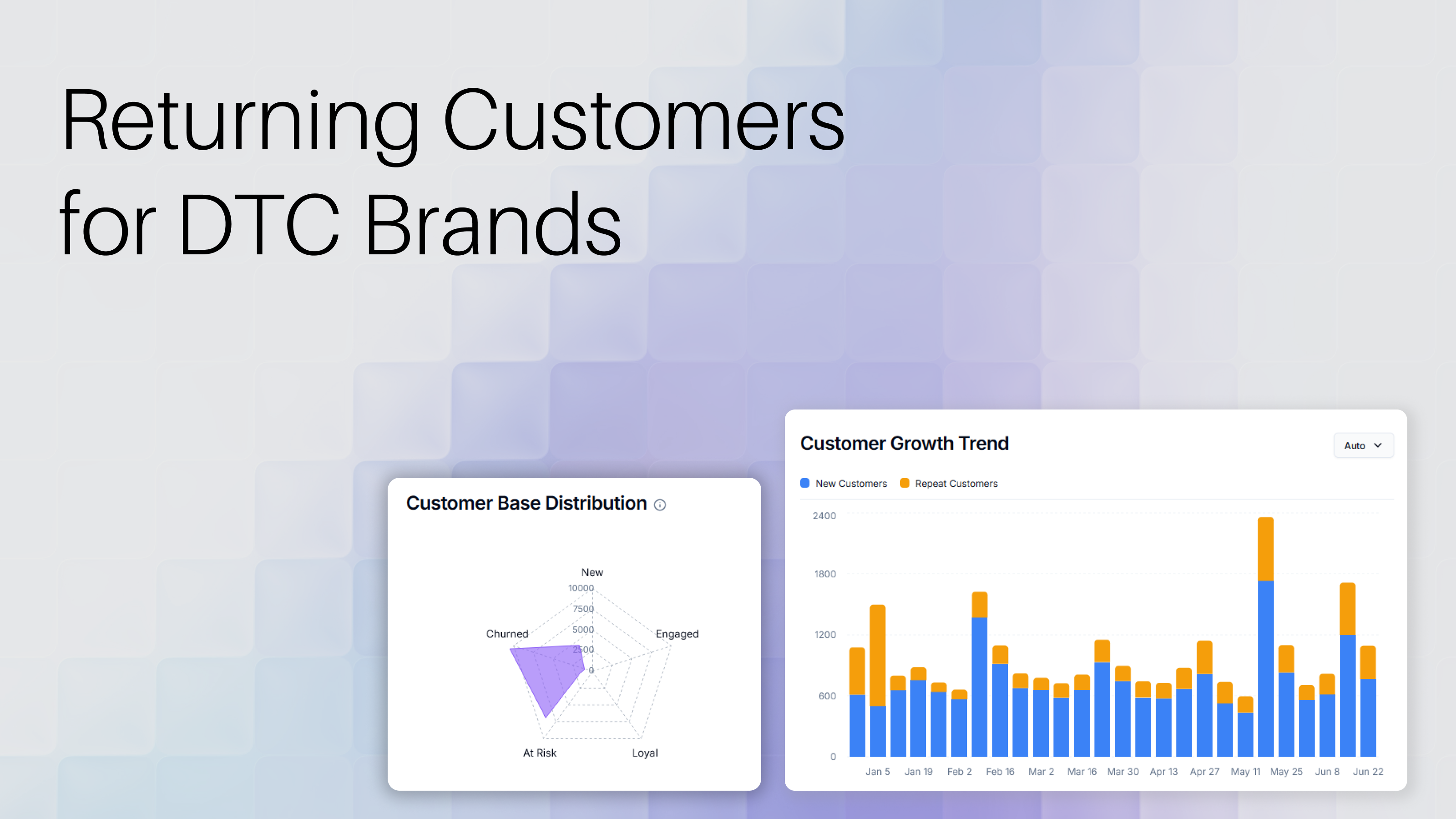
Treating all customers the same is the mistake. The useful move is to split your base into lifecycle stages and act on each differently. A simple, powerful distribution:
- New — bought once, recently.
- Engaged — buying regularly.
- Loyal — frequent, high value.
- At risk — used to buy, but have gone quiet.
- Churned — lapsed well past their normal cycle.
Seeing this distribution at a glance answers the question acquisition metrics cannot: is your customer base getting healthier or hollowing out? A brand stacking up churned and at-risk customers while new ones trickle in is heading for trouble no matter how good this month's ROAS looks. The segments also tell you exactly where to spend your retention effort, because each one needs a different message.
Email Targeting and Winback
Once customers are segmented, email and SMS become precise instead of a blast to everyone. The highest-return plays:
Nudge new customers toward the second order. The jump from one purchase to two is the hardest and most valuable step in retention. A strong post-purchase flow, a thank-you with a gentle next-product suggestion, and a reason to return within the first few weeks all pull that second order forward.
Reward and deepen loyal customers. Early access, loyalty perks, and cross-sells to your best segment protect the revenue you can least afford to lose, and cost almost nothing to send.
Run winback campaigns for at-risk and churned buyers. This is where most brands leave money on the table. A targeted winback sequence, a "we miss you" message, a reminder of what they bought, sometimes an incentive, can recover customers you already paid to acquire. Winning back a lapsed customer is almost always cheaper than buying a brand-new one.
The point of segmenting is that the at-risk winback and the loyal-customer reward should never be the same email. Relevance is what makes retention marketing work.
Return Windows and Timing
Timing is the lever most brands overlook. Every product has a natural return window, the typical gap between orders. A coffee subscriber reorders every few weeks; a skincare customer every couple of months; an apparel buyer on a much longer, seasonal cycle.
Knowing that window changes everything about when you reach out. Send the replenishment reminder or the next-purchase nudge just before the customer would naturally run out or start looking, and you catch them at the moment of highest intent. Send it too late and they have already lapsed, or bought from someone else. For consumables especially, mapping the return window and triggering timed reminders (or offering subscribe-and-save) is one of the most reliable ways to lift repeat purchase rate and, with it, LTV.
The catch is that the return window is different for every product and every segment, so it is nearly impossible to manage by eye. It has to come out of your actual order history.
How to Track It Reliably
All of this depends on knowing, at any moment, who your customers are and where they sit in their lifecycle. That is harder than it sounds, because the signals are split: order history in Shopify, email engagement in Klaviyo, and the acquisition cost behind each customer in Meta and Google. Rebuilding customer segments by hand across those tools is slow, brittle, and out of date the moment you finish.
This is where a unified data model earns its place. When orders, email behavior, and ad spend read from one reconciled source, your customer base distribution, repeat purchase rate, and return windows become a live view you can act on, instead of a monthly spreadsheet project. The pre-built Shopify dashboards most operators rely on track new vs returning revenue and customer segments by default, and it ties directly into the KPIs an ecommerce manager watches each week.
Karbon Analytics calculates your customer segments automatically, new, engaged, loyal, at risk, and churned, across Shopify, your ad platforms, and Klaviyo, and shows you exactly who to focus on winning back. If you would rather see your returning-customer health at a glance than rebuild it by hand, start a free trial and connect your sources; your customer segments are live the moment they sync.
See who to win back, automatically
Karbon Analytics splits your customers into new, engaged, loyal, at risk, and churned across Shopify, your ad platforms, and Klaviyo, so you know exactly where to spend your retention effort. Set up in minutes, updated daily.
Keep reading