What Is Customer LTV? Lifetime Value for DTC Shopify Brands
TL;DR
- Customer LTV (lifetime value) is the total gross profit a customer generates across every order they ever place, not just their first purchase.
- The simple formula is LTV = average order value x purchase frequency x customer lifespan x contribution margin.
- LTV only means something next to CAC (customer acquisition cost). The LTV:CAC ratio is what tells you whether acquisition is sustainable; 3:1 is the common healthy target.
- A first-order-only view of profitability makes paid acquisition look worse than it is, because it ignores every repeat purchase that follows.
- LTV is only reliable when order history, margins, and ad spend live in one reconciled source. That is the problem Karbon Analytics solves.
Most DTC Shopify brands acquire a customer at a small loss on the first order and make their money on the second, third, and tenth. If you only ever look at first-order profit, paid acquisition looks broken and you throttle the spend that was actually working. Customer LTV is the number that corrects that mistake.
It answers a question first-order math cannot: across the entire relationship, how much is one customer worth? Get it right and you know exactly how much you can afford to pay to acquire one. Get it wrong and you either starve growth or buy customers you can never recoup.
What Is Customer LTV?
Customer LTV, or lifetime value (sometimes written CLV or CLTV), is the total gross profit a customer generates over their entire relationship with your store, from first order to last. It counts every repeat purchase, not just the one that brought them in.
The word that trips people up is profit. LTV is not lifetime revenue. A customer who spends $600 across two years at a 30 percent contribution margin has an LTV around $180, not $600. Using revenue instead of profit is the most common way brands overstate LTV and overpay for acquisition.
There are two flavors worth naming. Historic LTV looks backward at what existing customers have already spent. Predictive LTV forecasts what a new customer will be worth based on early behavior. Most operators start with historic; it is simpler and honest.
The LTV Formula
The cleanest working formula for an ecommerce brand is:
LTV = AOV × Purchase Frequency × Customer Lifespan × Contribution Margin
In plain terms: how much they spend per order, how often they order, how long they keep ordering, and how much of each dollar you actually keep. The first three give you lifetime revenue; multiplying by contribution margin turns it into lifetime profit, which is the version you can compare against acquisition cost.
A quick word on contribution margin
Contribution margin is the share of each sale you keep after the costs that scale with every order: product cost (COGS), shipping, and payment fees. Most DTC Shopify brands sit between 25 and 40 percent. We break this down fully in the MER guide, where it sets your breakeven.
A Worked Example
Say a typical customer on your store behaves like this:
AOV: $60 · Orders per year: 3 · Stays a customer for: 2 years · Contribution margin: 35%
Lifetime revenue is $60 × 3 × 2 = $360. Multiply by the 35 percent margin and the customer's LTV is $126. That $126 is the ceiling on what you can spend to acquire them and still come out ahead over two years.
Now look at the trap. On the first order alone, that customer is worth $60 × 35% = $21 in gross profit. If your customer acquisition cost is $40, first-order math screams that you are losing $19 per customer and should cut spend. But across the full relationship you make $126 against that $40, a clear profit. The repeat orders are where the business lives, and only LTV sees them.
Free LTV Calculator
Plug in how a typical customer behaves to get your LTV instantly. It also returns lifetime revenue and the maximum CAC you could afford at a healthy 3:1 ratio, so you can see straight away how much you can spend to acquire one. Remember LTV is profit, so the contribution-margin field matters.
Customer LTV Calculator
Enter how a typical customer behaves. LTV is profit, so it accounts for your contribution margin.
Contribution margin is the share of revenue left after COGS, shipping & payment fees. Most DTC Shopify brands sit at 25–40%.
Customer LTV
$126
lifetime gross profit
Lifetime revenue
$360
before margin
Max CAC at 3:1
$42
affordable to acquire one
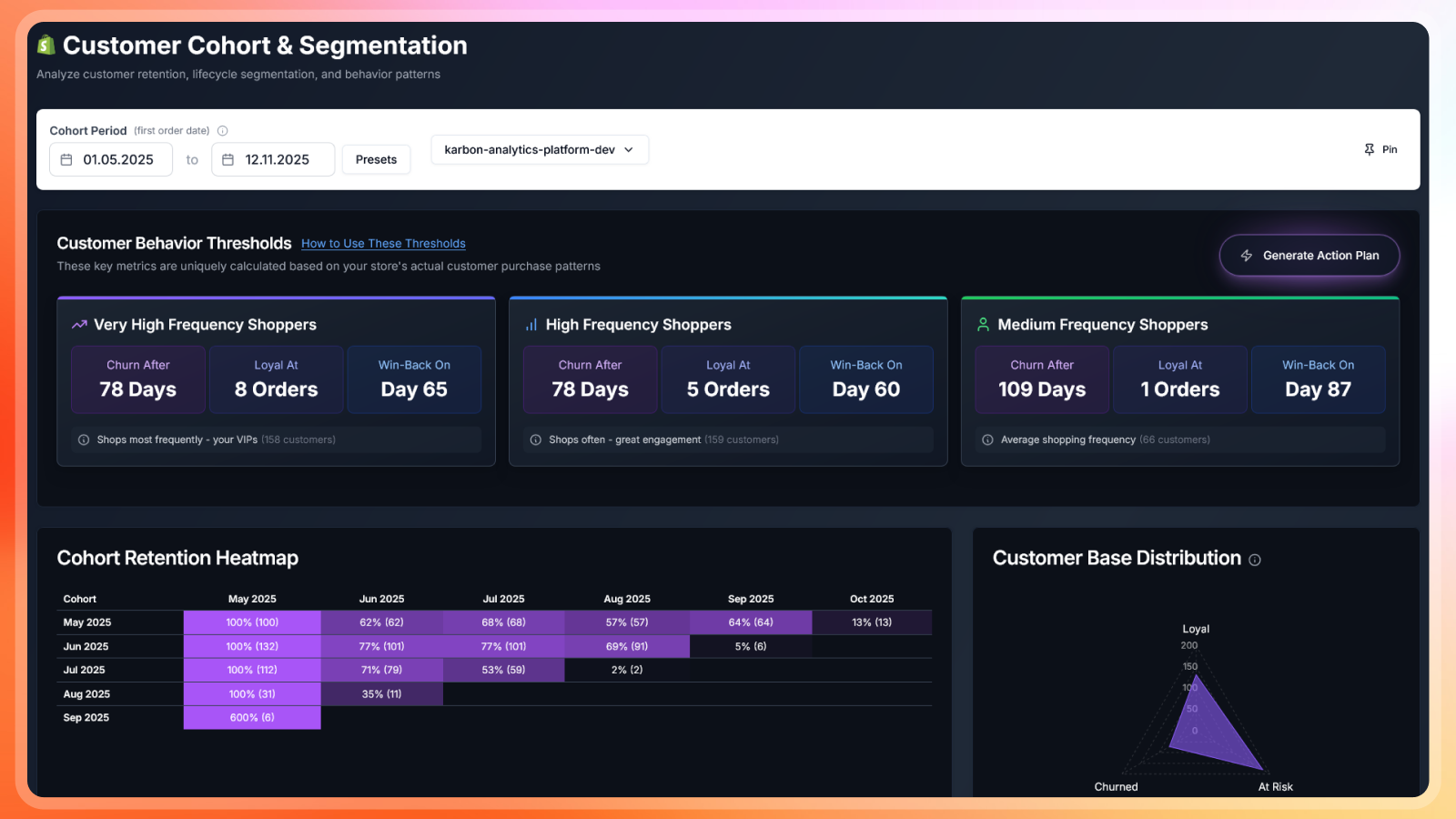
This is one average, calculated once. Karbon Analytics tracks real LTV by cohort and acquisition channel from your Shopify order history, and watches it against blended CAC every day.
Track my LTV automaticallyLTV:CAC, the Ratio That Matters
LTV on its own is just a number. It becomes a decision when you put it next to CAC, your customer acquisition cost: what you spend on sales and marketing to win one new customer. The LTV:CAC ratio is the single clearest read on whether your growth is sustainable.
The rough rules of thumb: a ratio near 3:1 is the healthy target most DTC brands aim for. Below 1:1 you are losing money on every customer. Around 1:1 to 2:1 you are growing but thin, and any rise in ad costs can tip you into the red. Above 5:1 often means you are under-investing in acquisition and could profitably spend more to grow faster.
The honest version uses blended CAC, total sales and marketing spend divided by all new customers, rather than the CAC any single ad platform reports. Platform-reported numbers undercount cost the same way platform-reported ROAS overcounts revenue. We cover that gap in the blended ROAS guide.
What Is a Good LTV?
There is no universal good LTV, because it depends entirely on your category, price point, and how repeatable the purchase is. A consumable like coffee or supplements should have a high LTV relative to AOV, because customers reorder on a cycle. A one-time purchase like a mattress has a naturally low repeat rate, so its LTV leans almost entirely on the first order and any referrals.
The number to watch is not the absolute LTV but two things: the LTV:CAC ratio, and the trend in repeat rate. A rising share of revenue from returning customers is the clearest sign LTV is improving, whatever the starting point. A brand that grows new-customer count while repeat rate quietly falls is buying a leaky bucket.
How to Increase LTV
Because LTV is frequency times lifespan times margin times order value, you raise it by moving any of those levers. Four do most of the work.
Lift repeat purchase rate. The biggest lever for most brands. A strong post-purchase email and SMS flow in Klaviyo, a subscribe-and-save option for consumables, and well-timed replenishment reminders all pull the second order forward, and the second order is the hardest one to win.
Raise average order value. Bundles, free-shipping thresholds, and post-purchase upsells increase the value of every order without touching acquisition cost.
Extend customer lifespan. Loyalty programs, genuinely good support, and a product people want to come back to all stretch the relationship. Every extra reorder cycle compounds directly into LTV.
Protect contribution margin. LTV is profit, not revenue, so discount discipline matters. A brand that trains customers to wait for a 25 percent off code is quietly capping its own LTV every month.
How to Track LTV Accurately
LTV is deceptively hard to track because it pulls from places that rarely sit together: order history and AOV from Shopify, repeat behavior over time, margins after COGS and shipping, and acquisition cost from every ad platform. Calculate it by hand and it is stale the moment you finish, and it almost never lines up with CAC over the same cohort.
This is where a unified data model earns its place. When Shopify orders, ad spend, and margins read from one reconciled source, LTV becomes a live view you can split by cohort, by acquisition channel, or by first product, instead of a quarterly spreadsheet project. The pre-built ecommerce dashboards most operators rely on track LTV and LTV:CAC side by side for exactly this reason.
Karbon Analytics calculates LTV and LTV:CAC for you automatically, blending Shopify order history, contribution margin, and blended acquisition cost across Meta, Google, and Klaviyo into one reconciled view, broken down by cohort and channel. If you would rather read your true lifetime value than rebuild it in a spreadsheet every quarter, start a free trial and connect your sources; your LTV view is live the moment they sync.
See your real LTV and LTV:CAC, by cohort
Connect Shopify and your ad accounts. Karbon Analytics tracks lifetime value against blended acquisition cost, splits it by cohort and channel, and updates daily. No spreadsheet, no guesswork.
Keep reading